Real estate investment and development appraisal—without
building another spreadsheet.
Investment and development appraisal on one page, on any
device. Build transparent monthly cash flows, solve to a target
return and export a formula-linked Excel model your colleagues and
lenders can follow.
Fast enough for initial pricing. Rigorous enough for investment
committee.
Terra is currently in private beta — access is
invitation-only. Request access above, or sign in if you are
already a tester. Testers start on a 14-day Pro trial; when it ends
your account moves to the free plan and your appraisals are kept.
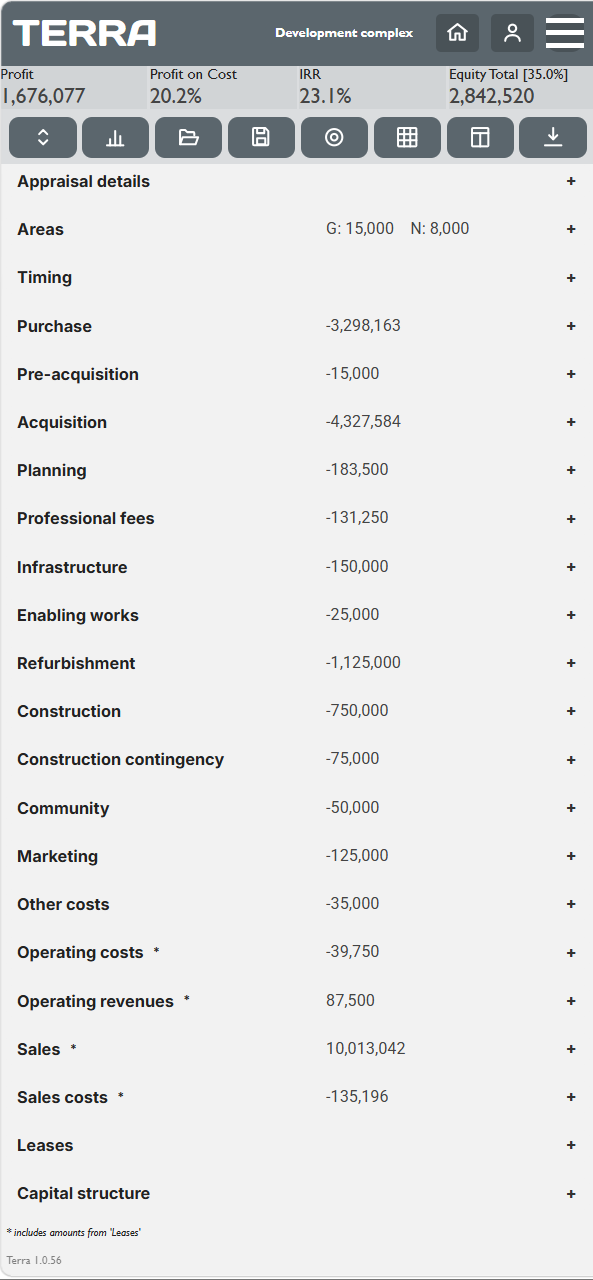
Terra on a phone. The same appraisal, the same numbers, on whatever
you have with you.
The rigour of XXX. The familiarity of Excel.
In the browser.
See it
One tool, two deliverables.
Terra is not trying to replace Excel. It replaces the work of building
the Excel model — and the errors that come with building it by hand.
Work fast in the Terra app; hand over a clean, professional Excel
model.
They look different by design — and that difference is the point.
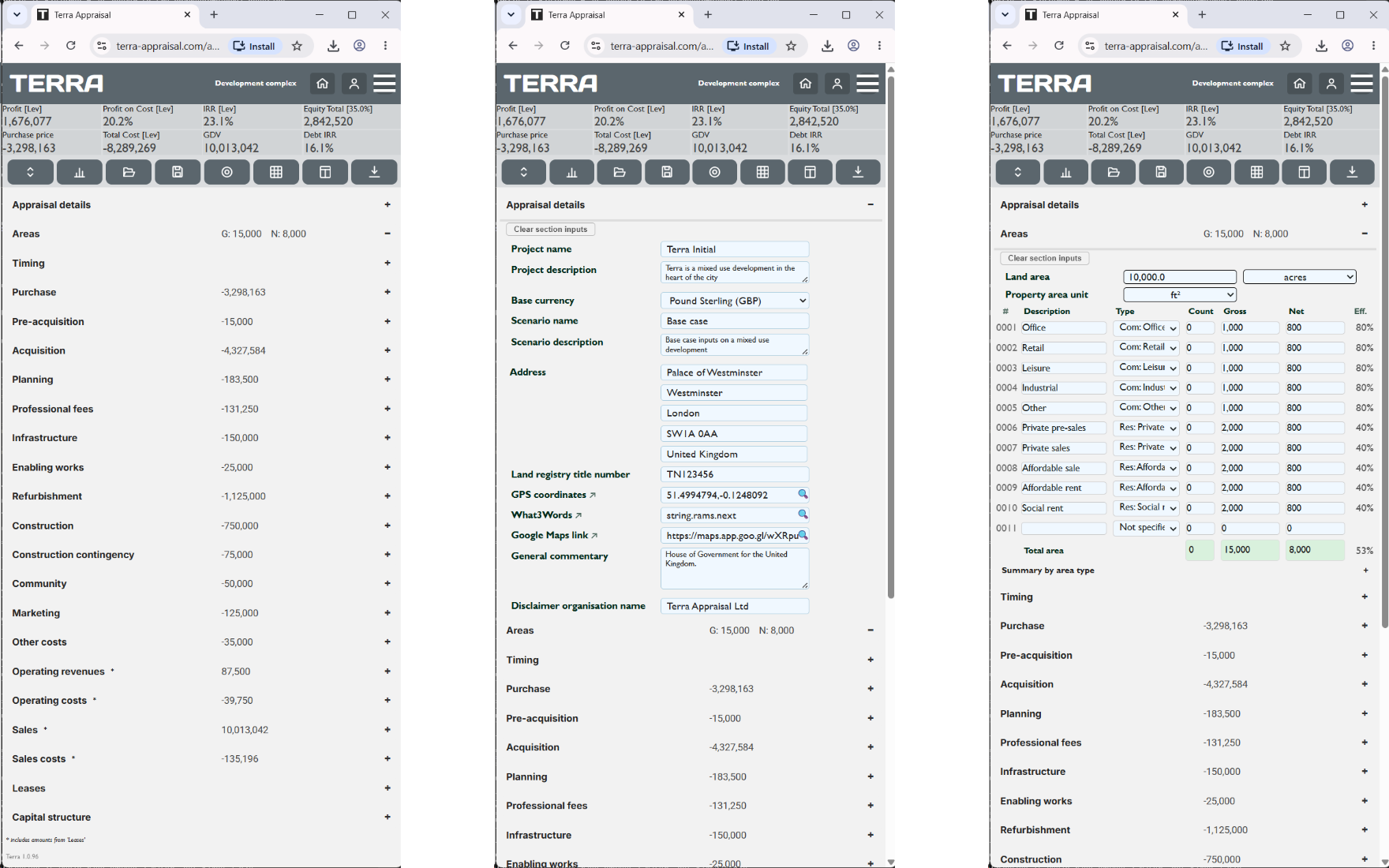
Enter your assumptions and watch the KPIs, IRRs and totals
update instantly; calculate the residual land value at the press
of a button, and solve to a target return. Built for speed and
clarity while you're thinking about the deal.
The Excel exportA model you can follow.
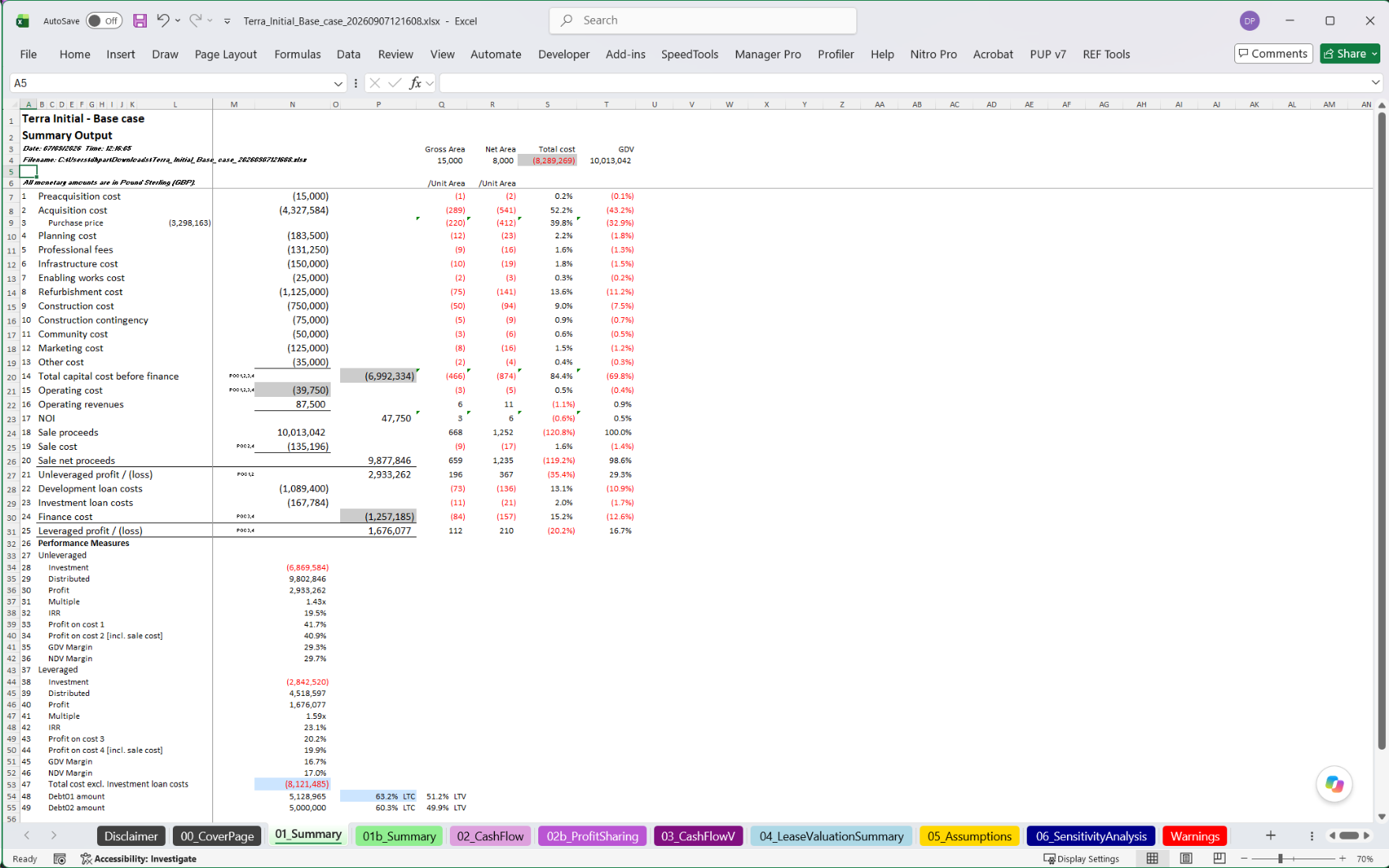
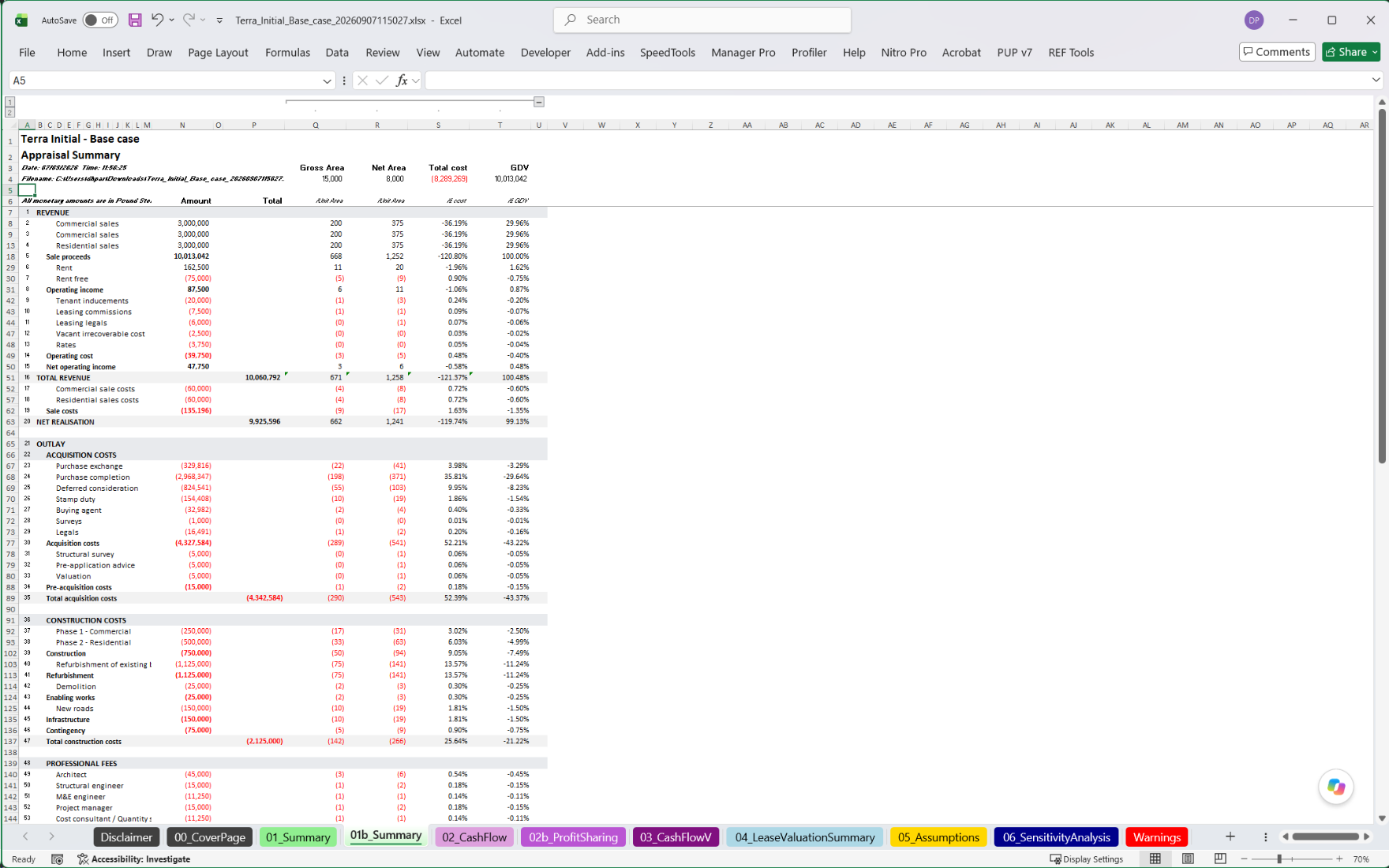
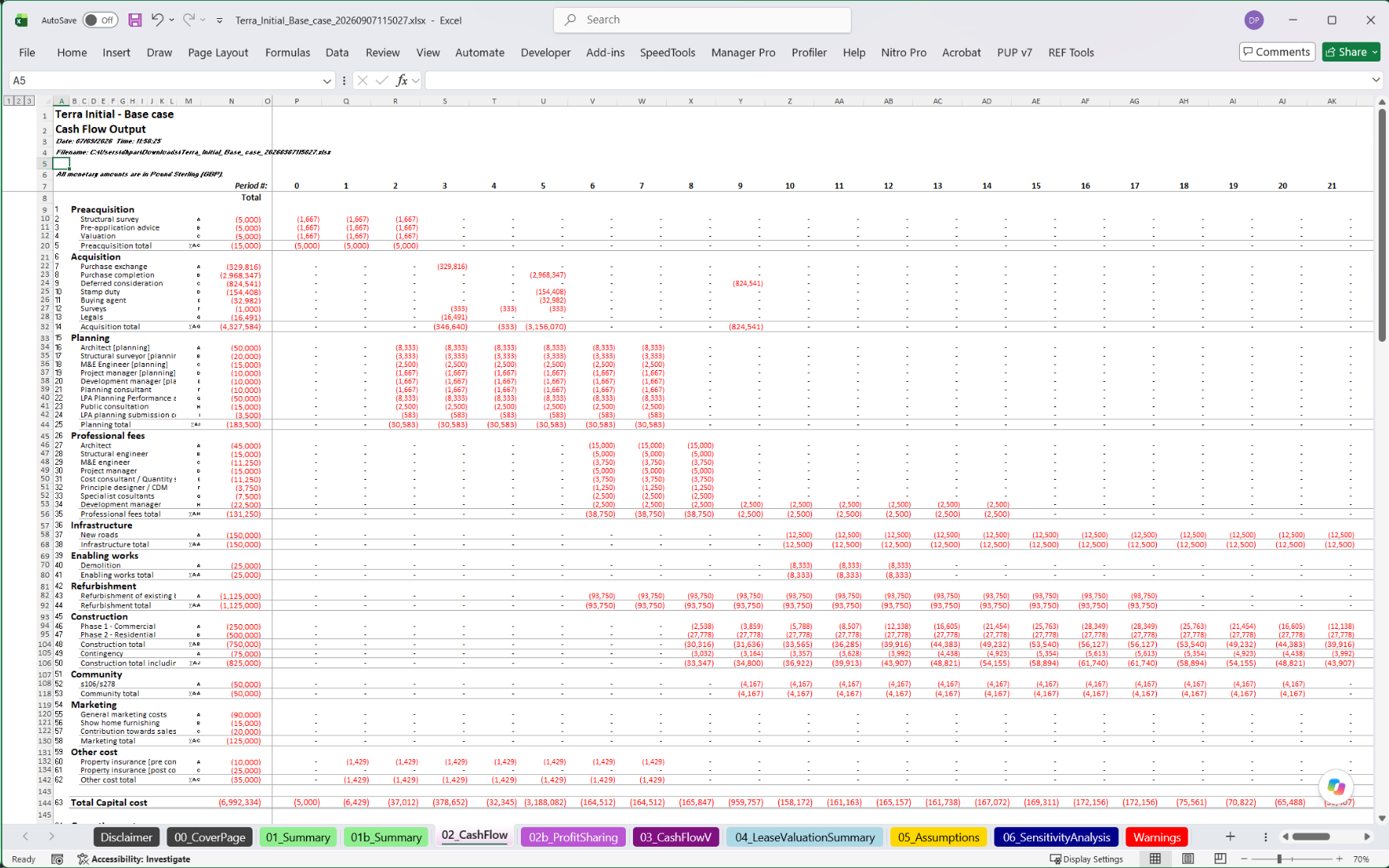
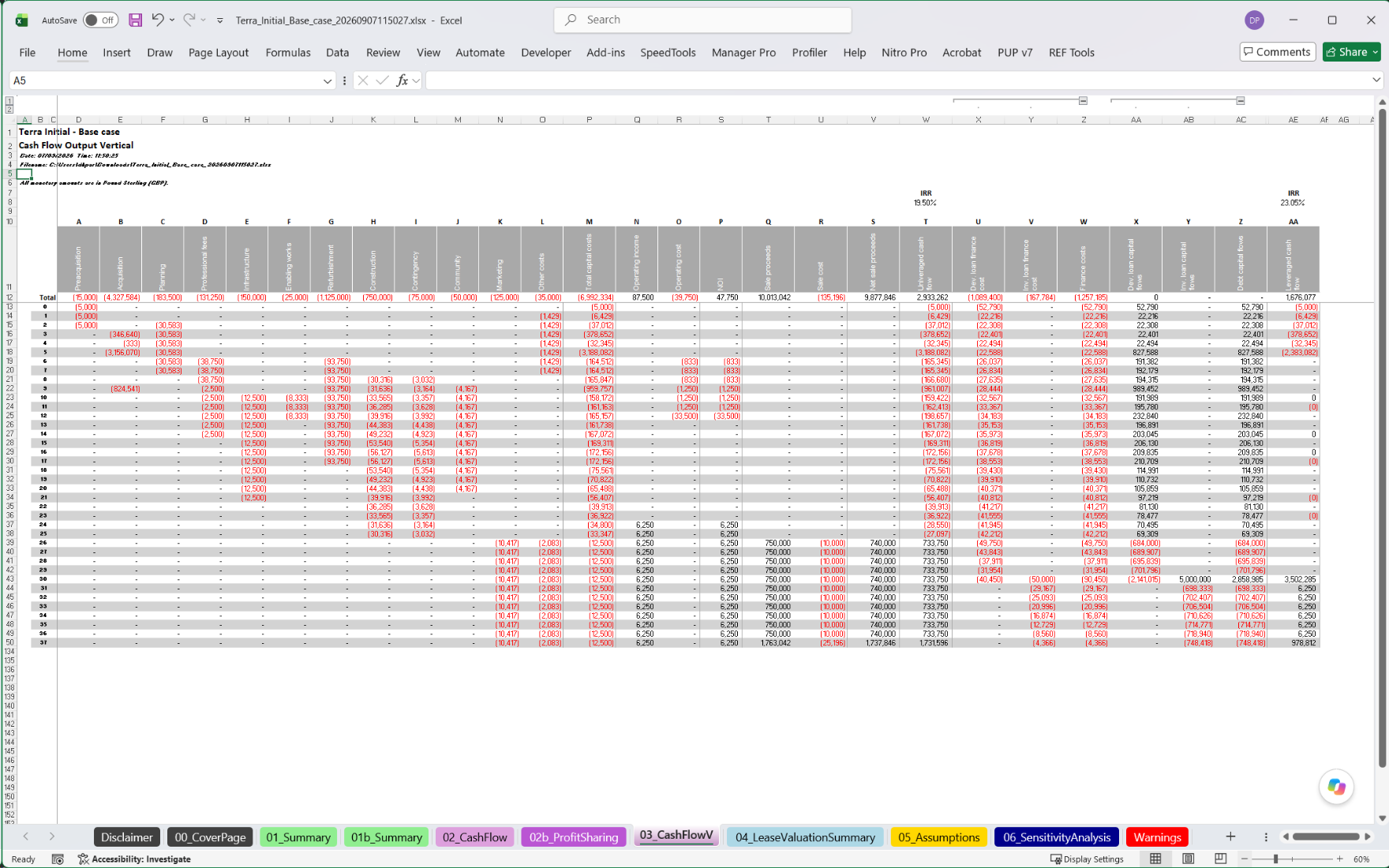
Every appraisal exports to a clean Excel model where the KPIs
trace through their totals down into the monthly cash flows,
and a full record of every assumption is set out on its own
sheet tab — exactly what was entered in the Terra web app. The
record is a statement of what was used, not a driver: the
workbook goes back into Terra when you want to change it. A
transparent
model your colleagues, lenders and investment committees can
follow line by line.
Built by property professionals, for property professionals.
Terra was developed from nearly three decades of real estate
investment, development and financial modelling experience, with input
from other property professionals — because appraisal software should
reflect how deals are actually analysed.
Why Terra
Better appraisal. Better decisions.
Technology should not replace professional judgement. It should make
professional judgement easier to apply.
Every appraisal turns on assumptions only experience can set —
rental growth, market rent, void periods, tenant quality, capital
expenditure, exit yields, and the probability of a lease renewing.
Terra will not make those calls for you.
What it does is give them a disciplined framework: one place to
enter them, test them, and see instantly what they mean for value
and return — so your judgement is applied, not buried in a
spreadsheet.
How it works
Less time building the model. More time thinking about the deal.
AI can help research the inputs. Terra structures the appraisal. You
make the judgement.
1
Open the opportunity
Enter your assumptions into sixteen identical sections for cost
and income, so every deal is structured the same way and two
appraisals can be compared line for line.
2
Review the numbers
Profit, profit on cost, IRRs and equity multiples — leveraged and
unleveraged, and you choose which — sit across the top of the
appraisal as you work, so you can see what an assumption is worth
before you commit to it.
3
Solve to target
Set the return you need and Terra solves back to the purchase
price that achieves it — then exports the whole appraisal to
Excel.
What you get
The appraisal on one page. Everything else one click away.
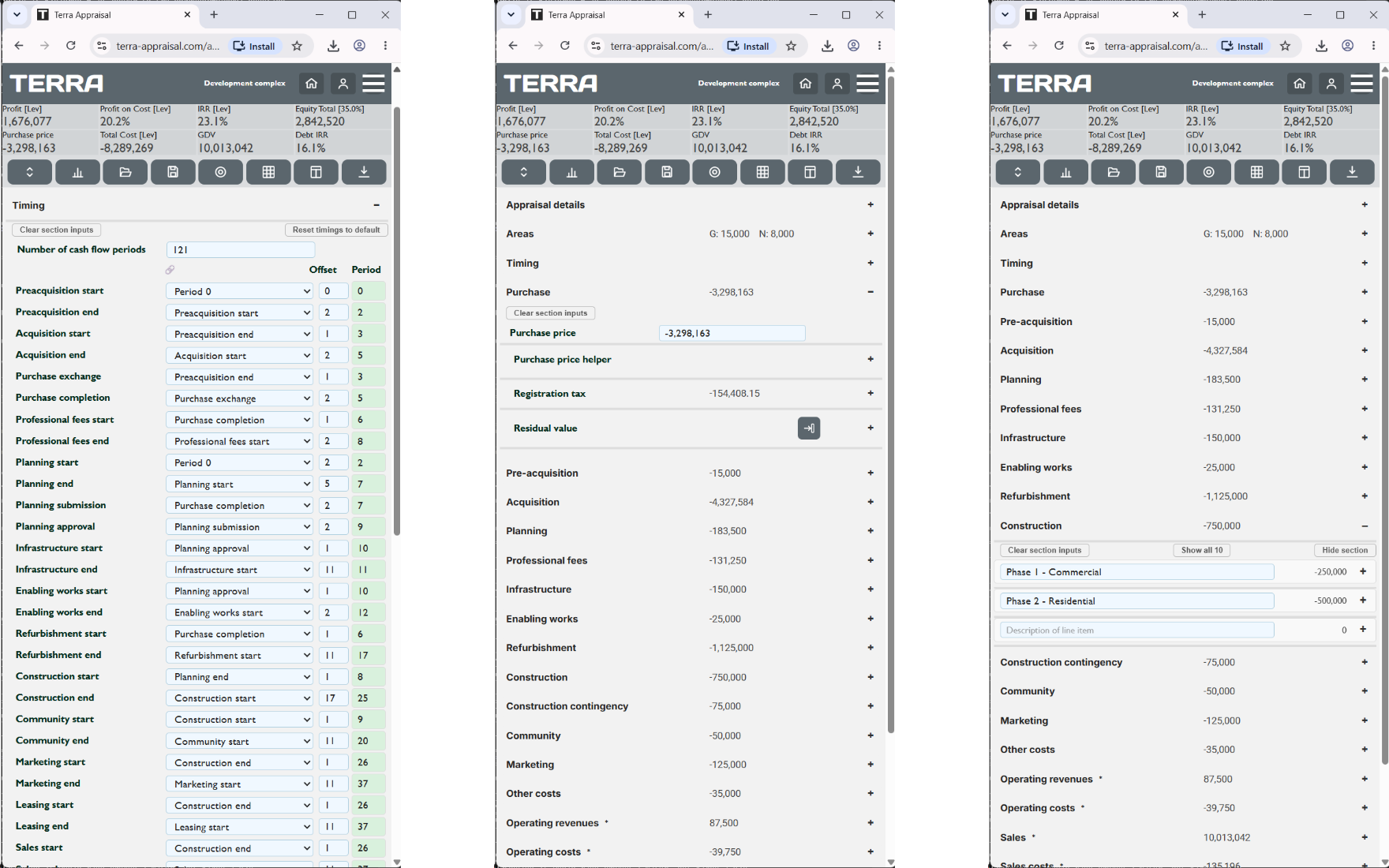
Sixteen identical sections, each with ten identical line items —
learn one and you have learned the appraisal. The rest is a click
from wherever you are on the page.
One page
The whole appraisal on one screen of collapsible sections — no
tabs, modules or wizards between you and the input you want.
KPIs you choose, always in view
Thirty-five to pick from, leveraged and unleveraged side by side,
arranged how you like and moving as you type.
The cash flow at a click
Every section, month by month, on screen — without opening Excel
or leaving the appraisal.
Solve to eleven targets
The purchase price that hits a target profit on cost, IRR, GDV or
NDV margin — leveraged or unleveraged — or a limit on your equity.
Sensitivity across several KPIs
One or two assumptions varied across a grid, every cell a full
re-run, as many KPIs in each cell as you want. Pro.
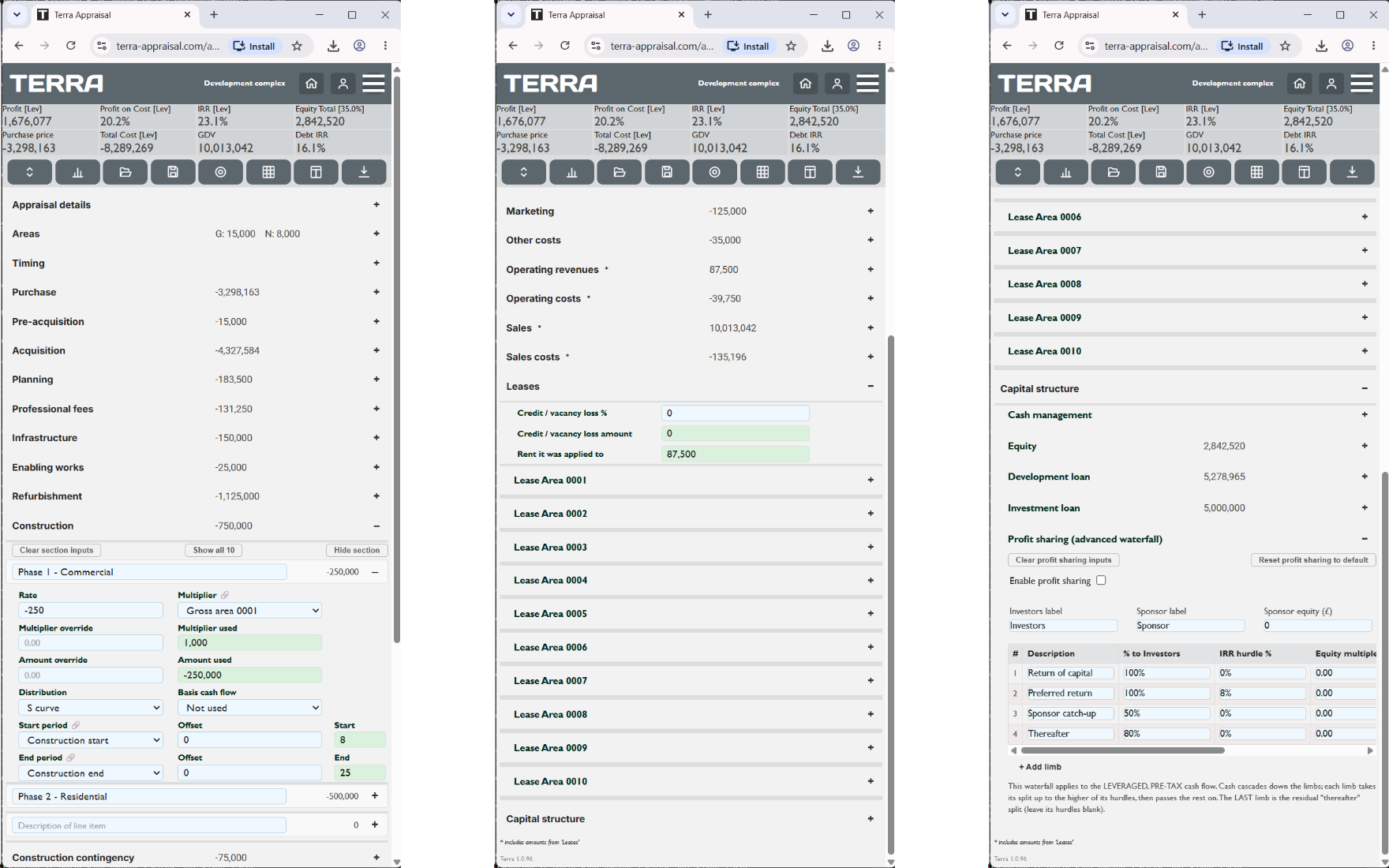
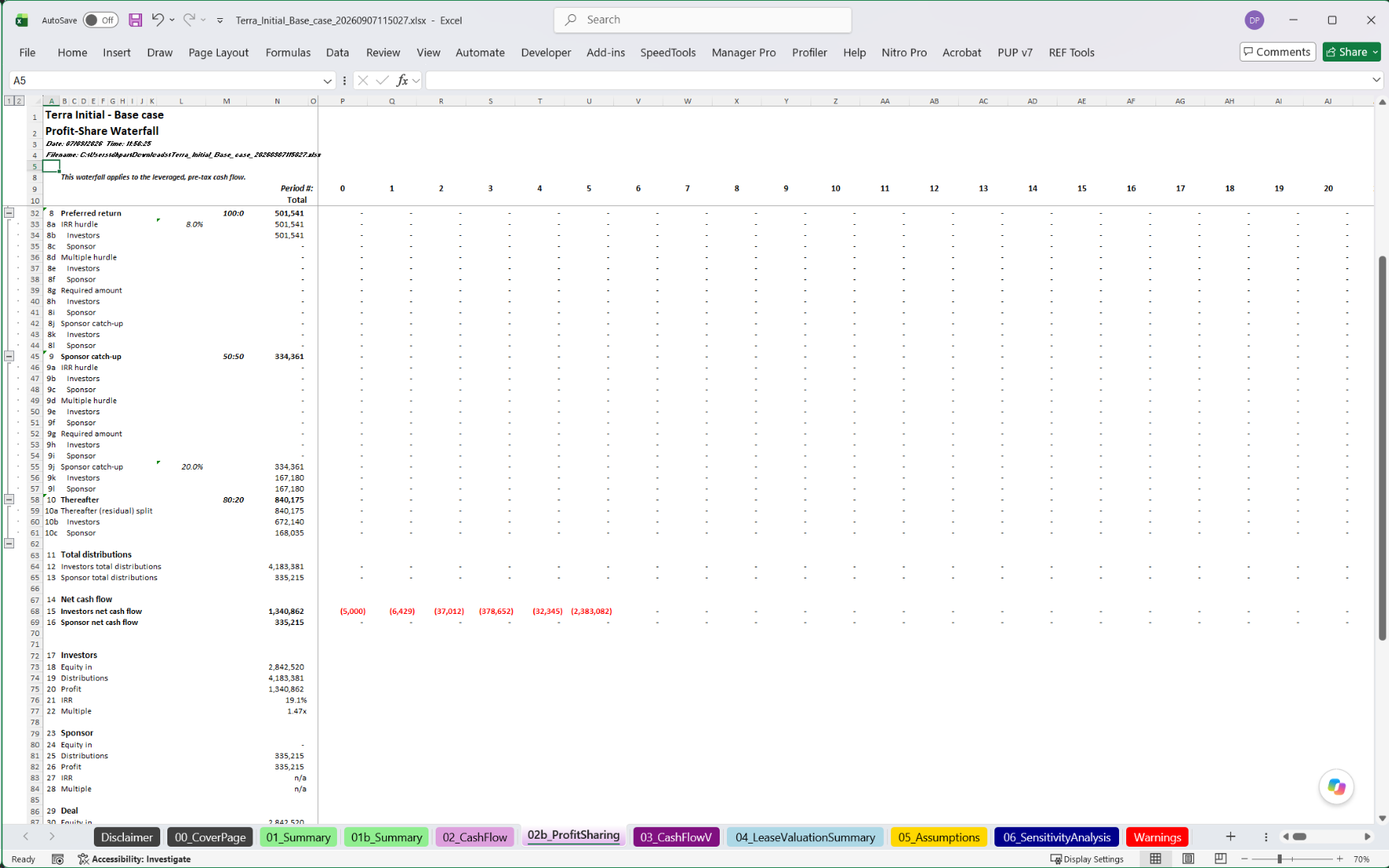
Promote waterfalls
Up to ten limbs with IRR and multiple hurdles, required amounts
and catch-ups — investor and sponsor returns reported as KPIs.
Pro.
Leases built for a hold
Ten lease areas, each with three lettings: rent reviews,
rent-free, review fees, commissions and voids — not a flat rent.
An appraisal that checks itself
Warnings appear on screen as you work and travel into the
workbook on their own tab.
Watch
A residual land valuation in Terra.
A two-minute walkthrough — from opening the opportunity to a residual
land value you can defend.
Transparency
Every headline number can be followed back.
When someone challenges a figure, you can show them where it came
from. In Terra's Excel model the KPIs, totals and balances are live
formulas rather than pasted values, so a question about profit on
cost is answered by following it down into the monthly cash flows —
not by rebuilding the appraisal to check. It's the browser-based
XXX alternative for people who like to see
the workings, not just the answer.
KPIs, totals and balances are live formulas — headline numbers can
be followed down to the monthly cash flows behind them
Every assumption you entered, set out in full on its own sheet
“AI can process information. Only you
can decide what an opportunity is worth.”
Terra does not remove the professional from the process. It removes
the unnecessary work around them.
Where Terra fits
Between the blank spreadsheet and the enterprise platform.
100% of what 90% of property professionals need.
Most appraisal happens at two extremes. Terra is built for the ground
in between — without the cost, complexity and implementation burden of
an enterprise platform.
Spreadsheets
Total flexibility — and total responsibility. You build, maintain
and debug every model. The errors are not always small ones, and
the worst are the ones nobody else can see.
Terra
The disciplined middle
Structured and fast in the browser, with a clean Excel model out
the other end — so every appraisal your team produces is built the
same way. No one's private spreadsheet, no version that only its
author understands, and no spreadsheet to build yourself.
Enterprise platforms
Tools like XXX are the institutional
standard — powerful and deep, with the complexity and the learning
curve that go with it, priced and scaled for large teams, and
tied to the desktop. Terra brings the same discipline without the
training, on whatever device you have with you.
Who it's for
Different users. Different assumptions. The same need for better
decisions.
Commercial real estate and residential opportunities alike —
development schemes and income-producing investments, appraised the
same disciplined way. From development and value-add through to
institutional and long-income — the same rigour whether you are
pricing a site today or underwriting a twenty-year hold.
Price a site while you are standing on it.
◈
Investment and agency surveyors
Price opportunities and advise with a defensible, consistent method.
◈
Developers and acquisition teams
Test residual land value and appraise schemes before you commit, and compare sites line for line.
◈
Investors and fund managers
Underwrite acquisitions and model returns for a multitude of sub-asset classes, from a simple investment through to long-income and development opportunities.
◈
Valuers and advisers
Produce transparent valuations clients and lenders can interrogate.
Yes, providing the key functionality of
XXX at a fraction of the cost, usable on
any device connected to the internet (unlike
XXX). You get monthly cash flows, IRRs and
residual valuations, and every appraisal exports to a clean Excel
model with formula-linked totals and KPIs. XXX remains the
enterprise standard; Terra brings fast, transparent appraisal to
anyone who wants to run it from a browser.
Does Terra work on a phone or tablet?
Yes. Terra runs in the browser on a phone, a tablet, a laptop or a
desktop, and the layout adapts to the screen you are on — the KPI
banner restacks, the input sections reflow, and the menus are
built for touch rather than a mouse. You can add it to your home
screen so it opens from its own icon, with nothing to download and
no IT ticket. It does need a connection: your appraisals live on
Terra's servers rather than on the device, which is what lets you
start one at your desk and open it on site.
What is residual land valuation?
Residual land valuation works out what a site is worth by taking
the completed development's value and deducting all the costs of
getting there — construction, finance, fees and profit. Terra
models this month by month, turning your assumptions into a
residual land value at the press of a button — and you can solve
back to a target return.
Can I export my appraisal to Excel?
Yes. You get a model you can follow, not a flat export of
numbers — the totals and KPIs are live formulas you can trace
down into the monthly cash flows behind them. It can go straight
to a lender, an investment committee or a client without you
reformatting anything first, and they open it in a tool they
trust.
And it comes back: upload a Terra Excel model into Terra and its
assumptions are read straight back in, so you can change them
and recalculate without re-entering the appraisal.
Does Terra do investment appraisals as well as development
appraisals?
Yes — both, in one product, with one set of inputs. A development
scheme and an income-producing investment are appraised on the
same page the same way, so a develop-to-hold is one appraisal
rather than two, and there is no second platform to buy or learn
for the other half of the job.
Which investment strategies does Terra support?
Development and value-add through to institutional and long-income
— one disciplined framework across the whole investment horizon,
whether you are pricing a site or underwriting a long hold.
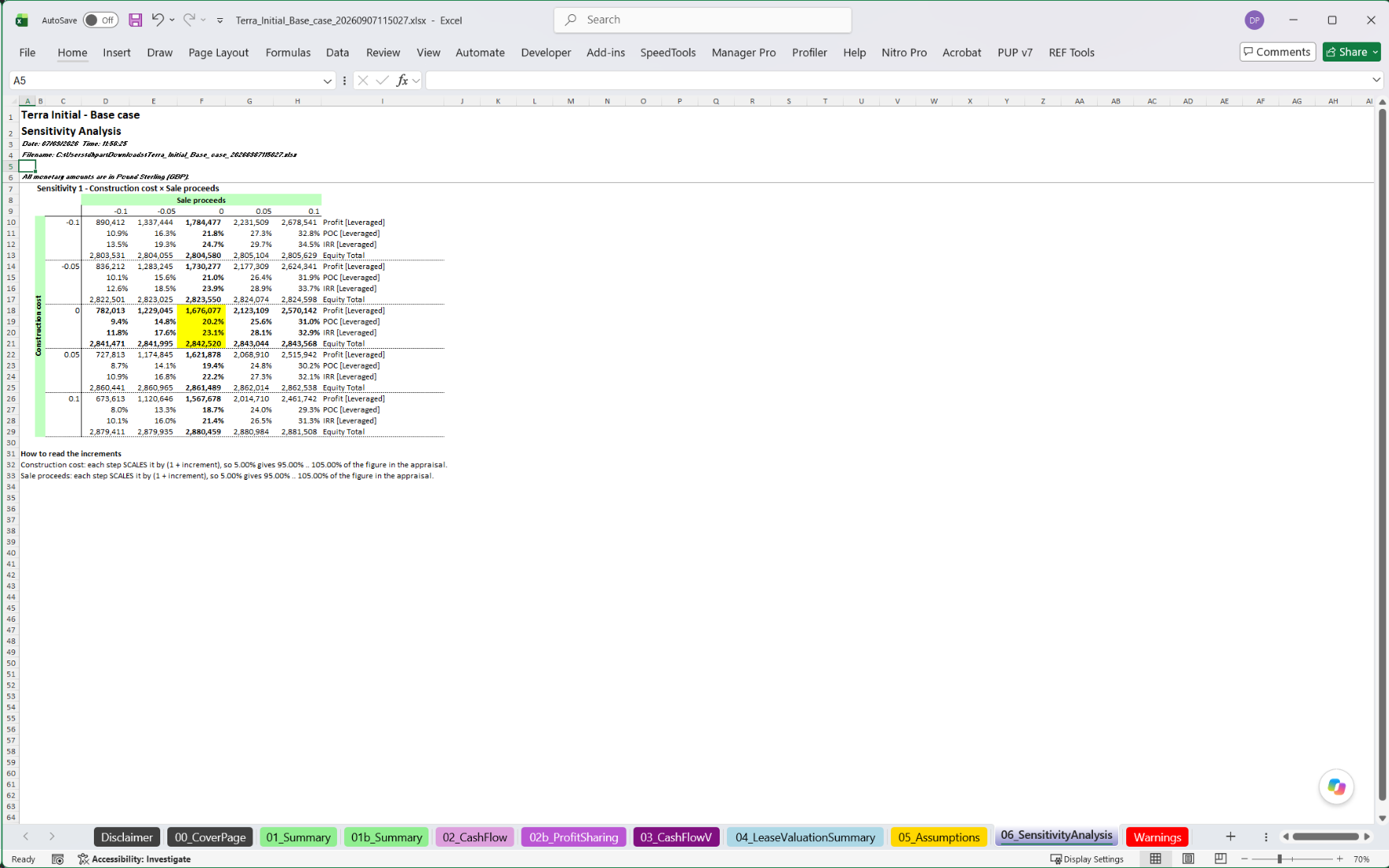
Can I run a sensitivity analysis?
Yes. Vary one or two assumptions across a grid — construction
cost against sale price, say — and Terra re-runs the whole
appraisal for every cell, reporting as many KPIs in each cell as
you choose rather than a single output. The grid prints to one
page and goes into the Excel model on its own sheet. Sensitivity
analysis is a Pro feature.
Can Terra model a profit-sharing or promote waterfall?
Yes. Split the equity returns between investor and sponsor
through up to ten tiered limbs, each with an IRR hurdle, an
equity-multiple hurdle, a required amount and a sponsor catch-up.
Investor and sponsor IRR and multiple are reported as KPIs on
screen, and the workbook carries the limb-by-limb breakdown on its
own sheet. Profit sharing is a Pro feature.
Is my data private and secure?
Your appraisals are private to your account, and nobody else sees
them unless you choose to share them with your organisation — with
one exception we would rather state than gloss over: if you report
a problem, a Terra operator can open the appraisal you were
looking at so we can reproduce it, and every time that happens it
is written to a log that cannot be edited or deleted.
Passwords are never stored in a form anyone can read, not even us.
Everything travels over an encrypted connection, and your sign-in
is held in a cookie that the pages in your browser cannot read.
Repeated sign-in attempts are blocked automatically, and
password reset links work once and expire within the hour.
Can I request a feature?
Yes, please do. Terra is in active development, and testers'
suggestions shape what gets built next. In the app, open the menu
at the top right and choose
Request feature / Report an error.
How do I get access?
Terra is currently in private beta, open to invited testers, who
start on a 14-day Pro trial. When the trial ends the account moves
to the free plan — the appraisal, the cash flows and the KPIs
stay, and anything saved to the account is kept until you
upgrade. You can
— tell us who you are and what you would use Terra for, and we aim
to respond within 24 hours. Existing testers can sign in at the
top of the page.
Open the opportunity. Enter the assumptions. Know what it is worth.
Terra is in private beta for property professionals.